
Most nonprofit leaders have heard that “positioning, messaging, and copy all need to line up.”
But very few have seen what that actually looks like when you build campaigns around real programs instead of abstract brand slogans.
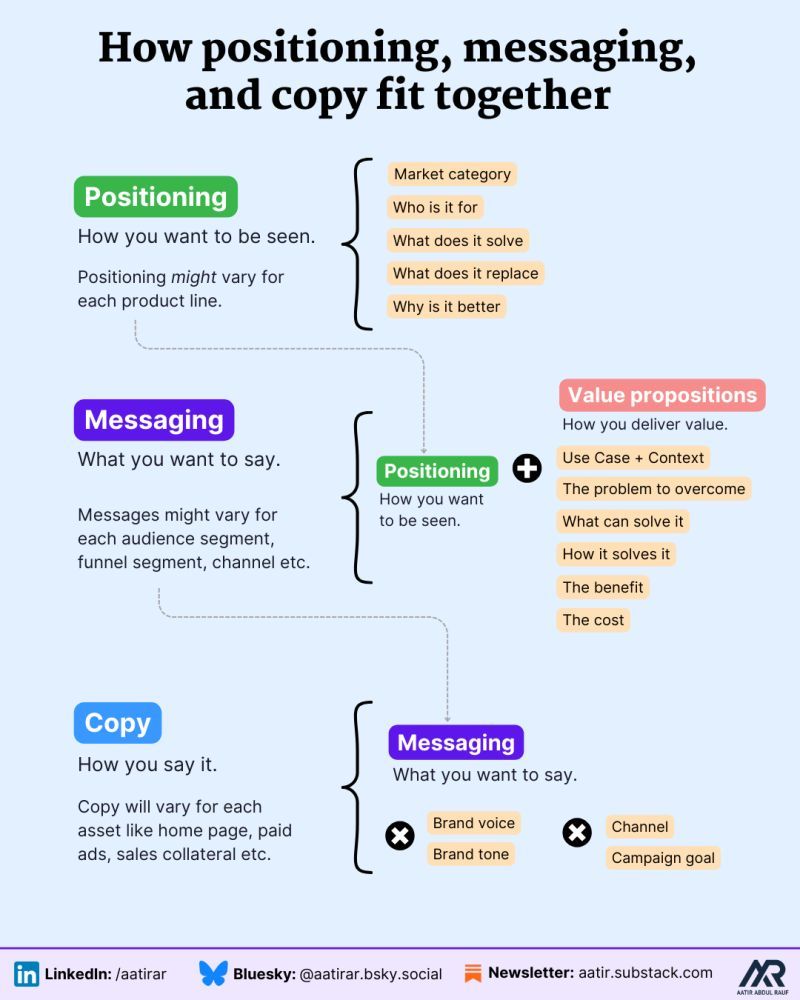
The graphic we’re looking at is a helpful 101‑level map, and in this post, I want to take you a layer deeper and put it squarely in the world of program‑centered nonprofit marketing.
Positioning: How your program wants to be seen (Serve)
In the graphic, positioning is “how you want to be seen,” defined by factors such as market category, who it is for, what it solves, what it replaces, and why it is better.
For consumer brands, that might sound like: “We’re the budget‑friendly project management tool for small teams.”
For a nonprofit, especially one with multiple programs, that framing can feel distant.
In program‑centered work, positioning sits under our Serve lens: center the people you exist for and the real world they live in.
Instead of starting with “what’s our big brand promise,” we start with one concrete program and ask questions like:
- Who is this program actually for, in real life?
- What world are they waking up to every day?
- What problem are they carrying that this program is designed to help with?
- What have they already tried to change it?
- What’s different about our way of helping?
Those are positioning questions—they determine the “box” your program lives in inside a pastor’s or donor’s mental warehouse.
When a bi‑vocational urban pastor hears about your cohort, you want them to instantly recognize, “This is for people like me, in a ministry context like mine, solving a struggle I actually have.”
When a donor skims your overview, you want them to say, “Oh, that’s the program that keeps pastors from burning out and churches from closing.”
Most nonprofits stop at one vague, organization‑wide positioning statement that tries to hold all programs at once.
Program‑centered positioning takes the graphic’s 101 insight—that positioning comes first—and applies it one program at a time under a shared theological and organizational umbrella.
Over time, your “brand” becomes the coherent sum of those program stories, instead of one slogan you’re constantly trying to stretch.
Messaging: Clarifying the story, audience by audience (Strategy)
The graphic defines messaging as “what you want to say,” and notes that it can vary by audience segment, funnel stage, and channel.
That’s exactly where our Strategy lens lives: turn program wisdom into a coherent argument that different audiences can actually hear and repeat.
Once you’ve done the positioning work for a specific program, messaging is about deciding which parts of that story matter most to which audience.
For example, imagine a year‑long discipleship and leadership program for front‑line urban church leaders:
For pastors, the core message might sound like: “You’re not alone. You can get practical, context‑honoring training without abandoning your church or your family.”
For donors, it might be: “Your giving keeps pastors in hard places from burning out and churches from closing their doors.”
For denominational or network partners, it might shift to: “This program helps you stabilize and strengthen the churches under your care without building a huge internal training department.”
The underlying positioning hasn’t changed.
The people, problem, and approach are the same.
But the angle of the story shifts based on what each audience is wrestling with and what kind of decision they’re trying to make—sign up, partner, give, advocate, or renew.
This is where many organizations feel the tension between “we need one clear message” and “we have different people to talk to.”
The 201 move is to hold a clear core story for the program and then intentionally translate it for each audience segment and funnel stage, instead of rewriting the story from scratch every time. Your argument stays coherent even as your headlines change.
Copy: Making it live in real assets (Support)
In the graphic, copy is “how you say it”—the specific words on your homepage, your ad, your email.
That’s the part everyone feels because it’s where deadlines live:
- “We need a brochure.”
- “We need an appeal.”
- “We need the grant narrative by Friday.”
In the ReadySetMIWI world, this is our Support lens: make it sustainable by turning positioning and messaging into concrete tools your team can run with.
Copy is the expression of the work you’ve already done upstream.
You don’t sit down to write an email and hope the right story emerges; you pull from a clear program positioning statement and a small set of key messages for each audience.
Practically, that might look like:
- A program landing page that clearly names who the program is for, what problem it addresses, how it works in their context, and what changes as a result.
- A short email series that walks a pastor through the same argument over time: status quo, things they’ve tried, your approach, concrete offer, picture of “new life.”
- A one‑sheet for donors that ties their gift directly to visible outcomes in that program, with ethical guardrails around how you talk about participants.
Copy varies by asset, but it’s all drawing from the same well.
When teams feel like every communication is a fresh brainstorm, it’s usually because positioning and messaging haven’t been done at the program level—or they exist in a deck nobody uses. Support work closes that gap.
Where value propositions fit: grounding “why it matters” in program reality
The graphic nests “value propositions” between positioning and messaging:
- How you deliver value
- What problem you help people overcome
- What can solve it
- How it solves it
- The benefit
- And the cost
That’s classic marketing language, but it’s easy for nonprofits to either ignore it or reduce it to a single paragraph in a case statement.
In a program‑centered approach, your value proposition is simply the clearest possible articulation of why this program matters to this audience, at this moment in their story. It’s where your theology of mission and your practical program design meet.
For example, for a trauma‑informed discipleship program, your value proposition for pastors might be:
- Problem to overcome: “Our people carry deep trauma, and our usual discipleship tools don’t seem to touch it.”
- What can solve it: “Biblically grounded, clinically informed practices that honor people’s stories instead of rushing them.”
- How it solves it: “We train your leaders with simple, repeatable tools and give them a community of peers walking the same road.”
- The benefit: “You see people grow in resilience, not just attendance.”
- The cost: “Time, courageous conversations, and a willingness to learn—but we walk with you.”
When you articulate value propositions like this for each key audience, you’re feeding high‑octane fuel into both your messaging and your copy.
Pastors hear the spiritual and practical benefit.
Donors hear why this program is a better use of resources than yet another generic campaign.
Partners see how it aligns with their mission and fills a gap they couldn’t fill alone.
A simple before/after: from “we need a brochure” to a program‑centered argument
Let’s pull this together with a familiar scenario.
The 101 version looks like this:
- Someone says, “We need a brochure for our urban ministry.”
- A staff member opens a blank document and tries to remember all the things leadership likes to say: “We empower,” “We catalyze,” “We equip.”
- The brochure ends up as a collage of brand phrases, program lists, and a couple of impact stats—accurate but forgettable.
The 201, program‑centered version starts very differently:
- You pick one flagship program: say, a nine‑month cohort for bi‑vocational urban pastors.
- You work through positioning: who it’s for, what world they’re in, what problem it addresses, what they’ve tried, and why your way is different.
- You define value propositions for each audience: pastors, donors, denominational partners.
- You outline key messages that flow out of that positioning and those value propositions.
- Only then do you sit down to draft copy for a one‑page overview, a landing page, and a short email sequence.
The finished brochure is still “just” a piece of copy, but now it’s carrying a coherent, program‑centered argument.
Staff can explain the program in a meeting the same way the brochure explains it on paper.
Donors can see a straight line between their gift and tangible outcomes.
Pastors can see themselves in the story.
That’s the move from 101 (understanding that positioning, messaging, and copy are different) to 201 (building a reusable, program‑centered stack you can actually run).
Try it with one program
If you want to experiment with this without overhauling everything, start small.
Choose one program that feels both important and fuzzy—people love it, but you regularly hear, “I’m not sure I could explain it to someone else.”
Then work through the graphic through the lens of Serve, Strategy, and Support:
- Serve (Positioning)
- Name who this program is truly for.
- Describe their current world and the specific problem they’re facing.
- Write one sentence on why your approach is different from what they’ve already tried.
- Strategy (Messaging)
- List your top two audiences for this program.
- For each, write 2–3 bullet points: what they most need to understand or feel to take a next step.
- Check that those bullets line up with the positioning you just wrote.
- Support (Copy)
- Pick one asset you already have (a page, a flyer, an email) and one you wish you had.
- For the existing asset, mark where it’s aligned with your new positioning and messages—and where it’s muddy or off.
- For the new asset, outline it by section, and note which positioning or message each section is carrying.
You don’t have to get it perfect.
The win is that you’re no longer treating “we need copy” as a starting point.
You’re building from a program‑centered understanding of Serve, Strategy, and Support that mirrors the positioning → messaging → copy stack in the graphic—but in language and practice that actually fits your ministry.
