
I recently read a quote on LinkedIn that shared:
"95% of companies are stuck in Chaos. Only 4% make it to Optimization. Just 1% ever reach true Innovation.
Why? Because most mistake activity for progress."
— Eric Partaker
He shared this image on his post:
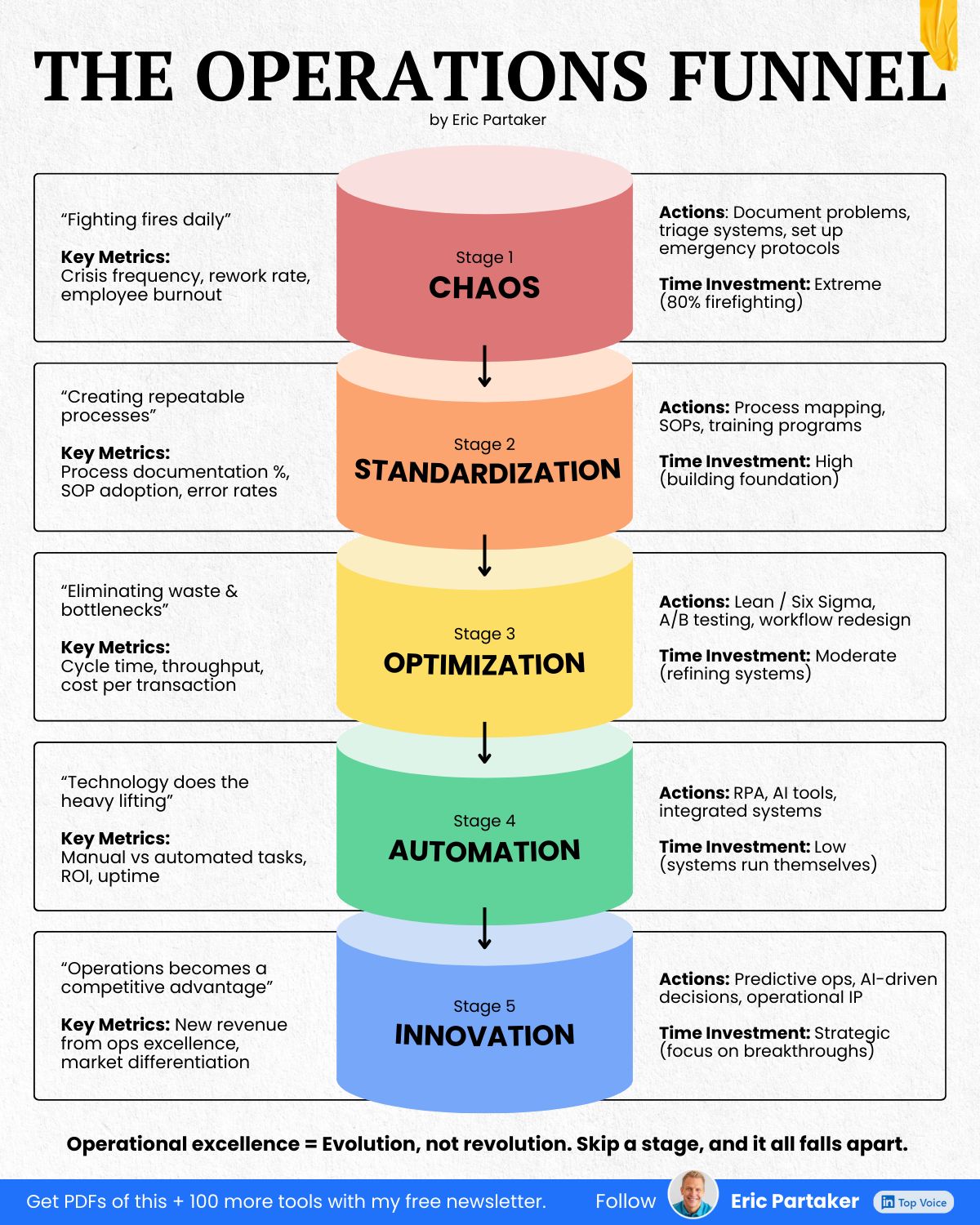
It made me stop and think.
Most nonprofit leaders don’t struggle because they lack passion.
Often, nonprofit leaders struggle because they’re trying to run a serious mission on top of an operating system that was never really built.
You probably feel it every week:
- Your calendar is shaped by last‑minute requests.
- Programs launch before anyone names the audience or the follow‑up plan.
- Someone says, “We should try AI,” and you think, “On top of what?”
And if you’re like many organizations, the first place this shows up is in communications.
The comms team is stretched.
- That’s the presenting problem.
- It’s rarely the actual one.
1. When “capacity” isn’t really about capacity
From the outside, it looks simple: the communications team is overloaded.
The calendar is full of deliverables. Campaigns are in motion. There’s more friction than there should be.
The workload is real. But the weight isn’t only the workload.
When communications feels strained, it rarely begins in comms. It starts upstream, in decisions that were never fully made.
That strain shows up in patterns like:
- No narrative hierarchy. Foundational messages, annual priorities, and reactive statements all compete at the same level, so nothing lands.
- No real audience priority. When every message has to speak to everyone, conviction softens and tone flattens.
- Strategy that resets each fiscal year. The public story never has time to build before it restarts.
- Vague advocacy thresholds. Visibility triggers ad hoc debate instead of clear action.
- Brand decisions without guardrails. Judgment calls keep escalating back to executives because the boundaries are undefined.
Most nonprofit comms teams are capable and thoughtful.
They’re just working inside systems that require them to translate strategic gaps and uncertainty.
When those gaps persist, communications becomes reactive by design.
Teams spend energy reconciling internal uncertainty instead of shaping public meaning. Leadership gets dragged into tactical decisions it shouldn’t be making. The brand doesn’t compound; it resets.
More resources won’t help if the architecture was never finished.
2. Name the chaos you’re actually carrying
Before you chase a new tool, hire, or campaign, pause and ask:
- How much of our week is spent firefighting?
- Where are we asking communications to compensate for decisions we haven’t finished upstream?
- Which of these feels true: no narrative hierarchy, fuzzy priorities, shifting strategy, vague thresholds, missing guardrails?
If your answers sting, that’s not failure. That’s clarity.
You’re a capable leader in a complex system. The chaos says more about the system than it does about you.
You can’t fix what you won’t name.
Once you see the chaos as an operating‑system issue—not a talent issue—you can start working on the right problem.
3. Understand the stages of your operating system
One helpful way to think about your operating system is in stages:
- Chaos – Firefighting, heroics, and everything feels urgent.
- Standardization – You create one shared way to do core work.
- Optimization – You refine that way, removing bottlenecks and rework.
- Automation – Tools take on some of the load because the process is clear.
- Innovation – Systems become a quiet advantage; new ideas plug in instead of blowing things up.
Most nonprofits live somewhere between Chaos and early Standardization.
They’re trying to do Stage‑4 work (AI, dashboards, complex campaigns) on top of Stage‑1/2 foundations.
4. How each stage feels in your comms week
Most frameworks talk about operations like they live in a back office somewhere.
But if you work in nonprofit marketing or communications, you feel every stage in your week.
When you’re in Chaos, it looks like “random acts of marketing” and last‑minute requests.
In Standardization, you’re fighting to get one default way to launch programs and send updates.
In Optimization, you start seeing the real bottlenecks in approvals, intake, and follow‑up.
Only after that does Automation (tools, AI, dashboards) actually reduce your load instead of increasing it.
So when we talk about building an operating system, we’re not talking about something abstract. We’re talking about reshaping the reality your comms team wakes up to every Monday.
Instead of asking, “How do we do more?” try:
- Which stage are we actually in right now?
- What would it look like to master this stage before we move on?
If you’re in Chaos, the win is not “better dashboards.” The win is one shared, realistic picture of your programs, audiences, and priorities—and a basic narrative hierarchy so everything isn’t competing at the same level.
If you’re in early Standardization, the win is not “AI content.”
The win is one simple, documented way to:
- Launch a program
- Invite people in
- Follow up afterward
…and clear guardrails so every communication decision doesn’t have to run all the way back up the ladder.
You don’t need to apologize for your stage. You just need to commit to doing this stage well.
5. Let marketing serve the operating system, not the other way around
When things feel overwhelming, it’s tempting to reach for “more marketing”:
- More posts
- More campaigns
- More channels
- More tools
But visibility isn’t the real problem if:
- Your leadership team hasn’t decided what truly matters most this year
- Your audiences aren’t prioritized
- Your comms team is constantly reconciling conflicting inputs
In that environment, marketing isn’t expressing a clear strategy. It’s translating leadership ambiguity.
Instead of asking, “How do we get in front of more people?” ask:
- If a new person wanted to engage with us this month, what’s the simplest, repeatable path we could offer?
- What do we want them to know, feel, and do at each step of that path?
- What needs to be true upstream—about priorities, audiences, and narrative hierarchy—for that path to make sense?
When you answer those questions, you’re not just tweaking messaging. You’re building the architecture that takes weight off your comms team instead of adding to it.
6. Start small: one program, one process, one bottleneck
You don’t need a full organizational overhaul to begin.
Pick one program that really matters in the next 6–12 months.
For that program, work through three moves:
- Clarify who it’s for.
- Who is this program really designed to serve?
- What problem, pain, or hope are you addressing for them?
- Define the path.
- How will they first hear about it?
- What’s the simple journey from “I’m aware” to “I’m involved”?
- What does “follow‑up” look like 30–60 days after their first step?
- Choose one process to standardize.
- Program launch? Intake? Volunteer onboarding? Donor follow‑up?
- Write the current steps honestly. Then sketch what “good” would look like in 3–7 clear steps.
Once you see the process, ask:
Where does this usually stall, create confusion, or generate rework?
That bottleneck is your 90‑day focus. You haven’t automated anything yet. But you’ve already started moving from Chaos toward Standardization and Optimization—in a way your team can feel.
7. Let operational excellence be your next breakthrough
It’s easy to believe your next breakthrough will come from:
- A new campaign idea
- A viral piece of content
- A big donor or grant
- A new platform or AI tool
Those can help. But they’re not a substitute for an unfinished operating system. Your real breakthrough may look quieter:
- A shared intake process that stops last‑minute requests before they hit comms
- A clear narrative hierarchy that keeps every message from competing for “most important”
- Audience priorities that tell your team who each piece is really for
- Brand and advocacy guardrails that let your staff make confident decisions without constant escalation
This isn’t glamorous work.
But it’s the work that turns communications from a pressure point into a force‑multiplier—and keeps your team healthy enough to do this for the long haul.
8. A gentle, practical challenge
Before you say yes to the next tactic, ask yourself:
- Is this helping us finish the architecture we’re asking our team to live in?
- Or is this another way to avoid the slower, deeper work of building a real operating system?
You don’t have to fix everything this quarter.
You don’t need a perfect blueprint. You just need to stop fighting the same fires in the same ways.
So for the next 90 days:
- Choose one stage to own (Chaos, Standardization, Optimization, Automation, or Innovation).
- Choose one program that really matters.
- Choose one process and one bottleneck to work on together.
Leaders who do that—quietly and consistently—are the ones whose missions, teams, and public stories are still strong ten years from now.
You don’t have to untangle this alone
If reading this stirred a quiet, “That’s us,” your next step isn’t to push harder—it’s to get a clear, outside look at the system you’re asking your team to run.
If you’d like a partner in that work, we’d be glad to help.
- We’ll map where your organization sits in the Chaos → Innovation stages
- We’ll choose one program, one process, and one bottleneck that would actually change your team’s week
- You’ll walk away with a simple, realistic next‑stage plan—whether we keep working together or not
Start with a low‑pressure conversation:
Reach out to our team, and we’ll send you a short intake and a link to book a call.
Give your team the gift of a system that fits the weight of your mission.
